

Navigating and Understanding Buyer’s Stamp Duty (BSD) and Additional Buyer’s Stamp Duty (ABSD) for Property Purchase in Singapore
When purchasing a property in Singapore, it is essential to be aware of the stamp duties involved. There are two types of Stamp Duty for buying a residential property in Singapore. The Buyer’s Stamp Duty (BSD) is a tax imposed on all the residential property’s purchase price. Additionally, the Additional Buyer’s Stamp Duty (ABSD) applies to specific buyer profiles, such as Singaporean who already owned a residential property and buying another, foreigners, entities and Singapore Permanent Residents (SPR). buying a second property. These duties are pivotal in financial planning and need to be factored into your budget. Here is why comprehending BSD and ABSD is crucial:
Financial Planning
- Budgeting: BSD and ABSD are substantial costs on top of the property purchase price. Knowing these expenses in advance helps prospective buyers plan their budget effectively.
- Avoiding Overstretching: By understanding these duties, buyers can avoid overstretching their finances, ensuring they make a property investment that aligns with their financial capabilities.
Legal Compliance
- Avoiding Penalties: Failure to comply with BSD and ABSD regulations can result in penalties and legal issues. Understanding these duties helps buyers fulfill their legal obligations, ensuring a smooth and hassle-free property acquisition process.
Investment Decision-Making
- Property Selection: Knowledge of BSD and ABSD helps buyers make informed decisions about the type and value of the property they can afford, narrowing down their options effectively.
- Tax Planning: For individuals considering multiple property investments, understanding ABSD rates for different buyer profiles is crucial for tax planning and optimizing investment portfolios.
BUYERS STAMP DUTY (BSD)
How Is Buyer’s Stamp Duty (BSD) Calculated?

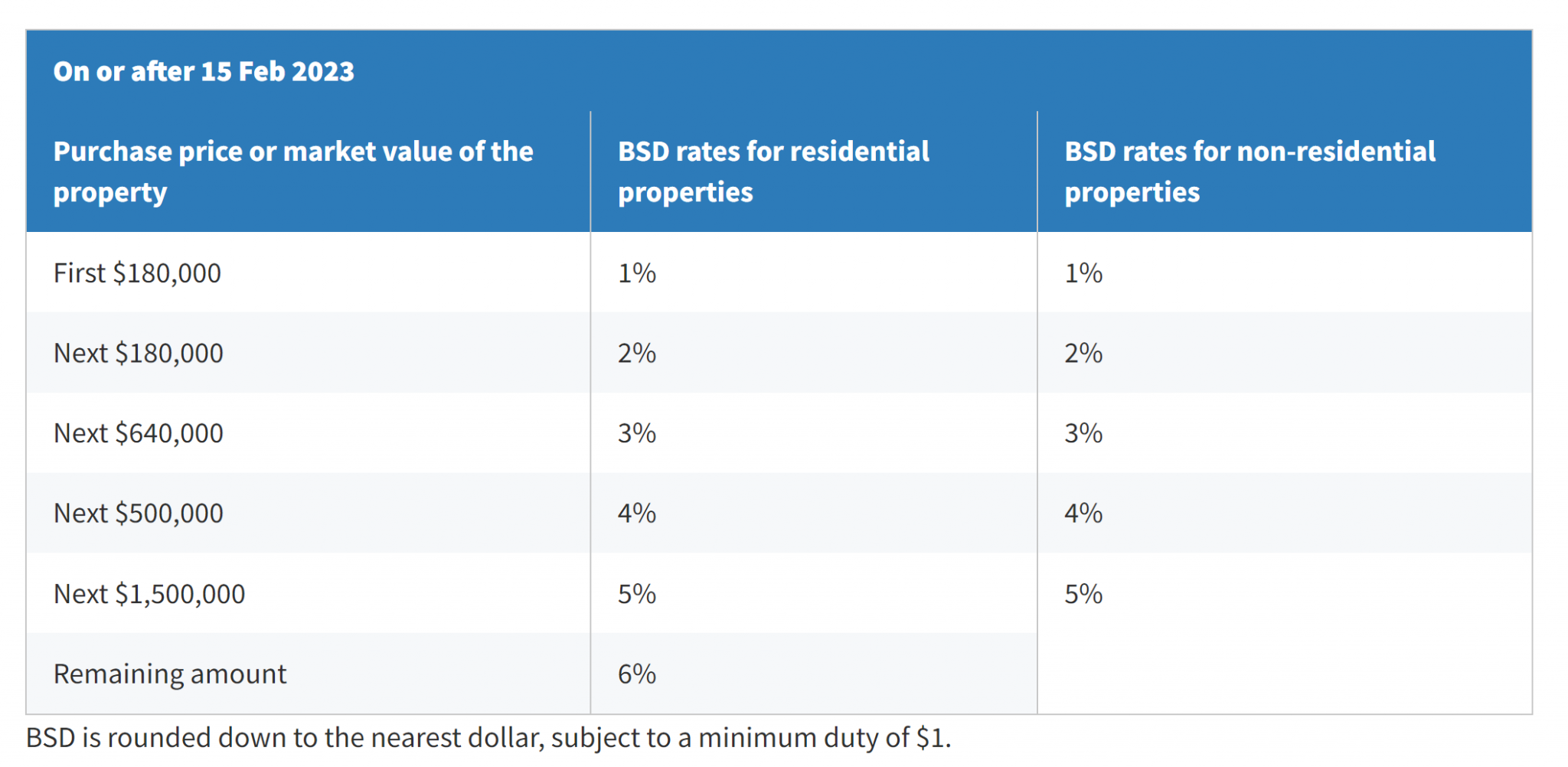
BSD is computed based on the purchase price or market value of the property, whichever is higher. Prior to 20 Feb 2018, the BSD rate was up to 3%. With effect from 20 Feb 2018, there are differentiated BSD rates between residential and non-residential properties. The BSD rate for acquisition of residential properties from 20 Feb 2018 to 14 Feb 2023 is up to 4%. From 15 Feb 2023, the top marginal rate for residential properties is 6%, and the top marginal rate for non-residential properties is 5%.
Buyer’s Stamp Duty (BSD) is a tax levied on the purchase of residential properties in Singapore. It is calculated based on the property’s purchase price or its market value, whichever is higher. BSD is payable by both locals and foreigners, applying to all property transactions, including the purchase of HDB flats, private condominiums, landed homes, and commercial properties.
Buyer’s Stamp Duty (BSD) Rates
The rates for Buyer’s Stamp Duty are progressive and vary based on the property’s purchase price. As of the latest regulations, the BSD rates for residential properties are as follows:
Examples
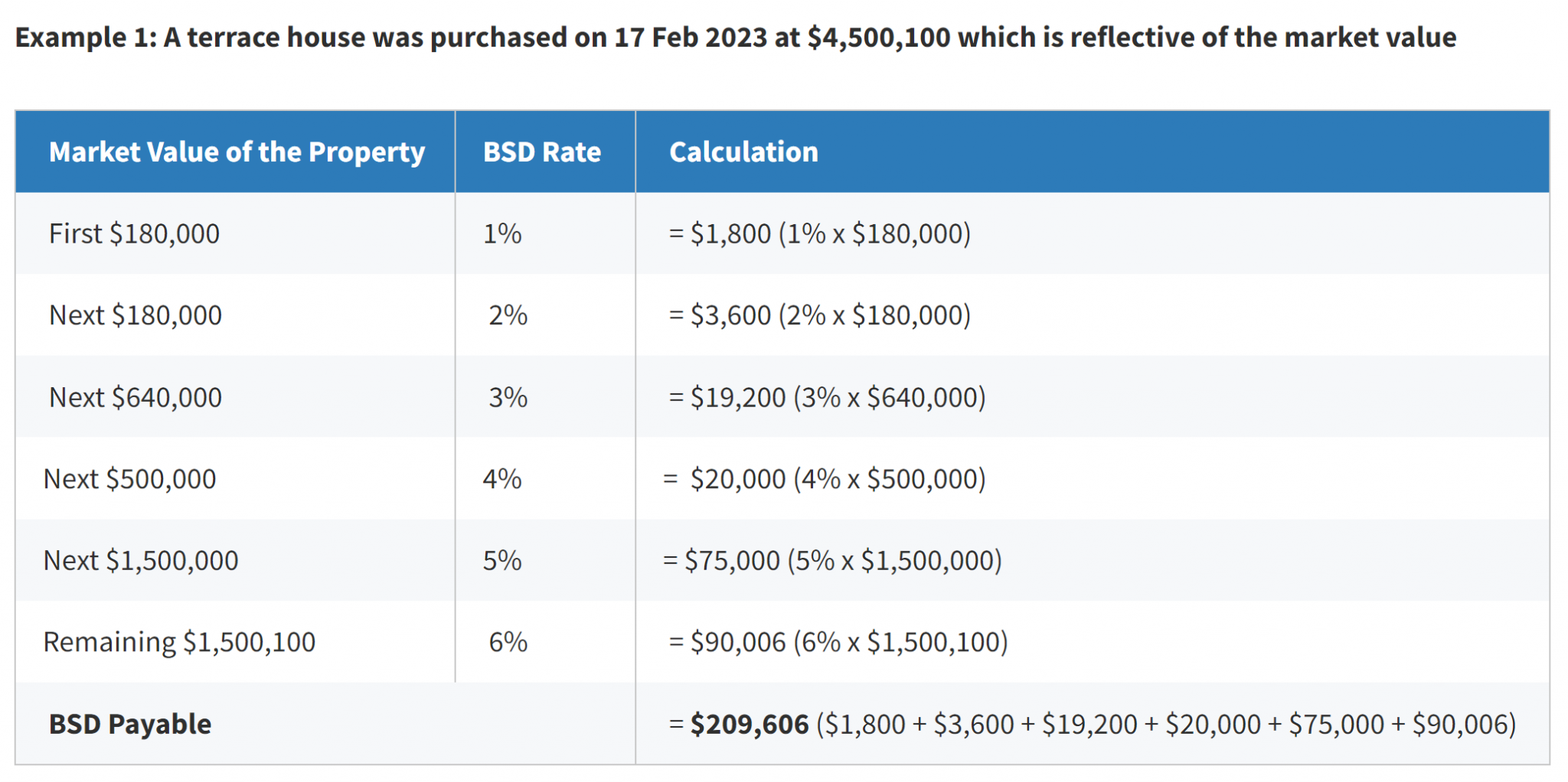
A terrace house was purchased on 17 Feb 2023 at $4,500,100 which is reflective of the market value
ADDITIONAL BUYERS STAMP DUTY (ABSD)
The Introduction and Evolution of Additional Buyer’s Stamp Duty (ABSD) in Singapore
In December 2011, Singapore implemented the Additional Buyer’s Stamp Duty (ABSD) as a strategic property cooling measure in response to the escalating demand for real estate. This move was aimed at managing the surge in property purchases, particularly by foreigners and entities, who were acquiring multiple residential properties. The primary goal was to create a sustainable housing market in the country.
The initial ABSD rates were further heightened in January 2013, coupled with the expansion of the buyer profiles that would be subjected to this tax. This increase in rates and the broader inclusion of buyer profiles had a significant impact. It led to a decrease in property speculation and acted as a deterrent for foreign investors interested in the Singaporean property market due to the elevated ABSD rates.
Following these developments, Singapore saw another spike in both Buyer’s Stamp Duty (BSD) and ABSD rates in July 2018. These measures were complemented by additional cooling strategies, such as the Total Debt Servicing Ratio (TDSR) and Seller’s Stamp Duty (SSD), resulting in a notable reduction in property transactions.
On December 16, 2021, a fresh set of cooling measures was announced, including another increase in ABSD rates. These measures were implemented with the objective of further stabilising the real estate market in Singapore. The latest round of property cooling measures officially came into effect on April 27, 2023, marking yet another adjustment in ABSD rates.
Over the years, ABSD has proven to be a crucial tool in regulating the property market, curbing speculative investments and ensuring a sustainable growth trajectory. The periodic adjustments in ABSD rates reflect the Singaporean government’s commitment to maintaining a stable property market and providing a conducive environment for both local and foreign buyers. By understanding the evolution of ABSD and its impact on property transactions, investors can make well-informed decisions in the ever-changing real estate landscape of Singapore.
Who Needs to Pay ABSD?
ABSD is primarily levied on specific categories of buyers. These include:
- Foreigners: Non-Singaporean citizens and non-permanent residents.
- Entities: Referring to entities, such as companies, partnerships, or trusts.
- Singapore Permanent Residents (PRs): PRs purchasing their second and subsequent residential properties.
- Singaporeans: Those acquiring their second and subsequent residential properties.
Additional Buyer’s Stamp Duty (ABSD) Rates
According to the new regulations, buyers who are liable for ABSD are required to pay this duty in addition to the existing Buyer’s Stamp Duty (BSD). Both BSD and ABSD are calculated based on the purchase price stated in the dutiable document or the market value of the property, whichever amount is higher. The rates for ABSD vary based on the buyer’s profile and the number of properties they own. As of the latest regulations, the rates for ABSD are as follows:
Defining ‘Residential Property’ for Additional Buyer’s Stamp Duty (ABSD)
To comprehend the concept of ‘Residential Property’ in the context of Additional Buyer’s Stamp Duty (ABSD), it is essential to recognise what falls under this category. Residential properties are defined as dwellings used as homes. This encompasses a wide range of housing types, including HDB flats, condominiums, bungalows and terrace houses, among others.
Additionally, properties like shophouses with living quarters and HDB void deck shops that have an upper floor designated for residential use are also categorised as residential properties under ABSD regulations. It is worth noting that when it comes to overseas property purchases, these properties are not considered in the property count for ABSD purposes. This distinction is crucial for individuals navigating the regulations and obligations related to ABSD in the real estate market.
Defining ‘Entity’ for Additional Buyer’s Stamp Duty (ABSD)
In the context of Additional Buyer’s Stamp Duty (ABSD), an ‘Entity’ pertains to an entity that is not an individual and is characterised by the following criteria:
Unincorporated Association: This refers to a group or organisation that lacks legal incorporation but operates as an entity with specific goals and purposes.
Trustee for a Collective Investment Scheme: An entity acting as a trustee for a collective investment scheme is included in this definition. This encompasses scenarios where a trustee manages investments collectively for multiple investors.
Trustee-Manager for a Business Trust: An entity serving as a trustee-manager for a business trust is also categorised under this definition. In this capacity, the entity manages the affairs and operations of a business trust.
Partners of a Partnership: The term ‘Entity’ includes the partners of a partnership, regardless of whether any of them is an individual. This applies when the property being conveyed, transferred, or assigned is intended to be held as partnership property.
Understanding these criteria is essential for individuals and organisations engaging in property transactions, ensuring compliance with ABSD regulations and avoiding legal complications.
Are There Any Exceptions to Additional Buyer’s Stamp Duty?
Certain scenarios exist where you might be exempt from paying the Additional Buyer’s Stamp Duty (ABSD). These situations include:
Contracted Sale: If you have already entered into a contract to sell your current residential property before signing the Option to Purchase (OTP) for your new property, you are not required to pay ABSD.
Downgrading to HDB: If you are transitioning from private property to an HDB resale flat, ABSD is not applicable.
Dual-Key Condo Units: While not technically an ‘exemption’, some families opt for dual-key condo units. These units are sold as a single property (thus, no ABSD is levied) but consist of two separate homes – a primary unit and a sub-unit.
Decoupling: Decoupling occurs when co-owners decide to divide ownership of their shared property between them. Although decoupling is legal, it becomes problematic if used for tax evasion. The Inland Revenue Authority of Singapore (IRAS) recently announced regular audits to prevent “contrived or artificial” arrangements. Whistle-blowers exposing individuals exploiting schemes like the “99-to-1” arrangement to evade ABSD may be rewarded with up to $100,000.
Free Trade Agreements (FTAs): Nationals and Permanent Residents of countries like Iceland, Liechtenstein, Norway, Switzerland, and the United States of America are treated the same as Singapore Citizens (SCs) under specific Free Trade Agreements. Consequently, ABSD is not applicable for their first property purchase. To apply for remission, your legal representative can use the e-Stamping portal on IRAS’s website.
Understanding these exceptions is crucial for individuals navigating property transactions, ensuring compliance with ABSD regulations, and avoiding legal complications.
What About Foreigners Who Marry Singaporeans?

While it is established that Additional Buyer’s Stamp Duty (ABSD) is typically applicable to foreigners and Permanent Residents, there exists a specific scenario where these individuals are exempt from paying it. If you are a foreigner or Permanent Resident married to a Singaporean and do not own any residential property, you are not required to pay ABSD.
Furthermore, if you and your spouse, both as a married couple, are in the process of relocating to a new home, you can obtain an ABSD refund. To be eligible for the refund, the property for which you paid ABSD must be sold within six months of acquiring the second property. The detailed terms and conditions for this exemption can be found on the Inland Revenue Authority of Singapore (IRAS) website.
Is It Wise to Evade Additional Buyer’s Stamp Duty?
For many Singaporeans, investing in property is a popular financial strategy. Whether viewed as a means to generate passive income through rentals or as a secure method to preserve wealth, owning multiple properties is a common goal for securing financial stability. This perspective is hardly surprising, given the consistent resilience of property prices over the years.
At present, property prices across all types are at a peak. Following the latest round of property cooling measures implemented in April 2023, there is no doubt that the increased rates of Additional Buyer’s Stamp Duty (ABSD) will spark heated debates among property buyers and investors. Understandably, not many are in favor of this measure. After all, it represents an additional tax aimed at discouraging buyers by elevating property costs in Singapore, particularly affecting foreigners and entities engaged in speculation.
Given the circumstances, numerous property buyers explore exemptions and potential ‘loopholes’ to avoid paying the supplementary tax. While some of these methods might be effective, in most cases, it might be more practical and cost-effective to simply comply with the ABSD requirement. Additionally, although individuals may discover legal means to ‘avoid’ ABSD by exploiting ‘loopholes’, it is crucial to remember that tax evasion remains illegal, and abiding by the law should always be the top priority.
Understanding the nuances of BSD, ABSD and its exemptions demands professional expertise and meticulous attention to detail. With our dedicated team by your side, you can approach your property journey with confidence, knowing that you have a knowledgeable partner guiding you through every phase. Get in touch with us today to explore your property options and receive personalized advice tailored to your unique requirements and aspirations.